

What is Digital Impression?
When dental treatments are mentioned, most of us immediately think of fillings, root canals, implants, or aesthetic smile design. Because the treatment itself is usually the part that interests us most, the part we notice most. However, behind the scenes of all these procedures lies a crucial step that directly determines the success of the treatment: taking impressions.
You may recall the traditional methods… Large impression trays inserted into the mouth, putty-like materials, waiting for the paste to harden, struggling to breathe, and sometimes an involuntary gag… These are not very pleasant memories for most of us. Moreover, the precision of the impression taken with these methods depends entirely on the current situation; even the slightest error can affect the outcome of the treatment.
This is precisely where a technology rapidly gaining popularity in dentistry in recent years comes into play: digital impressions.
The era of taking impressions with a tray is gradually passing. Thanks to advanced digital scanners, the inside of the mouth can be scanned in just a few minutes, just like taking a photo or video. This technology not only simplifies the process; it also delivers much more precise, faster, and more comfortable results.
What is a Digital Impression?
A digital impression is a special device an intraoral scanner that scans the inside of your mouth like a camera, creating a highly detailed three-dimensional model of your teeth and surrounding tissues. No more impression pastes that grow, spill, and make breathing difficult, no more trays that sit in your mouth for minutes… In short, nothing uncomfortable.
Instead, the dentist uses a small scanner to scan your teeth in seconds, and while you’re comfortably seated, an exact digital model of your teeth is created on your computer screen. It’s fast, comfortable, and incredibly precise.
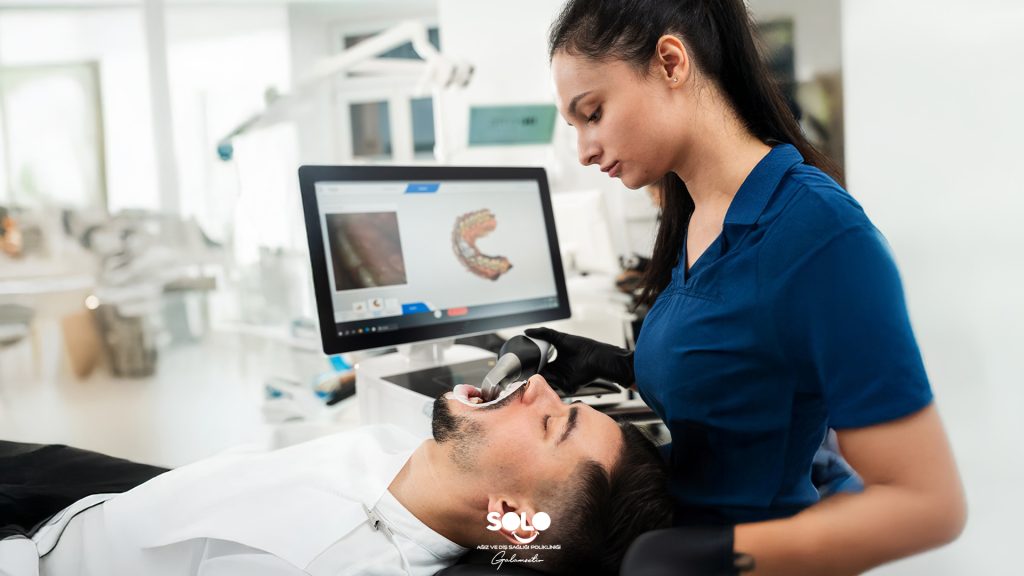
This digital model then forms the basis of many treatments. For example:
- Veneers
- Implant-supported dentures
- Orthodontic treatment planning
- Clear aligner applications
- Zirconium or porcelain work
- Custom-made appliances such as night guards
All of these procedures are now performed not with manual measurements but with digital data prepared with millimeter precision. This results in more consistent results and a much more comfortable treatment process.
How to Take a Digital Impression
When you first hear about digital impressions, they may sound technologically advanced and a bit complicated, but the truth is quite the opposite. The process is both very quick and extremely comfortable for patients. In fact, many people are surprised when the procedure is completed, asking, “Was that all?”
Let’s take a step-by-step look at the procedure:
The scanning device is prepared.
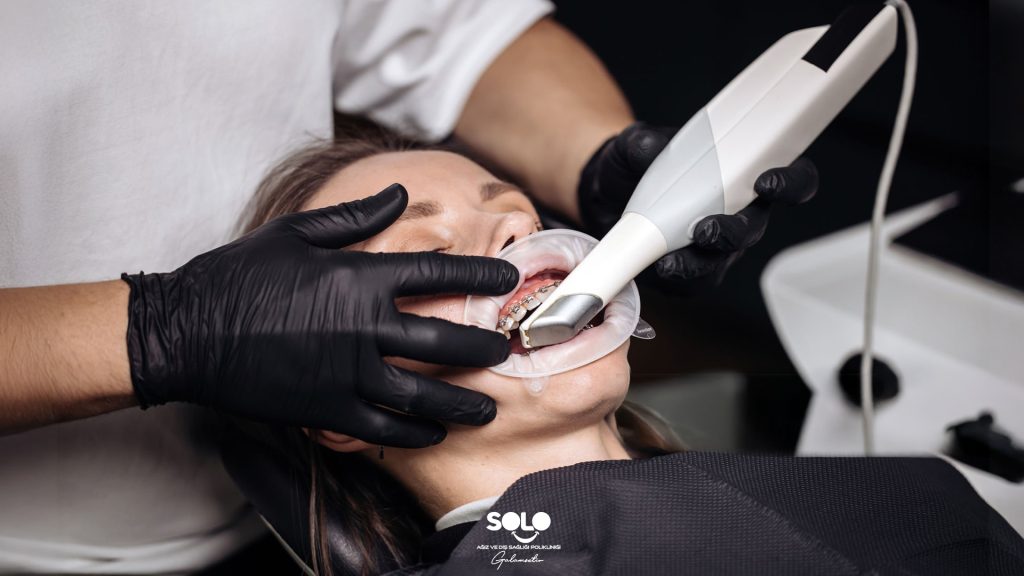
Your dentist prepares the intraoral scanner, a thin, small handheld instrument. It has a tiny camera on its end that provides high-resolution images of the inside of the mouth.
The tooth surfaces are gently scanned.
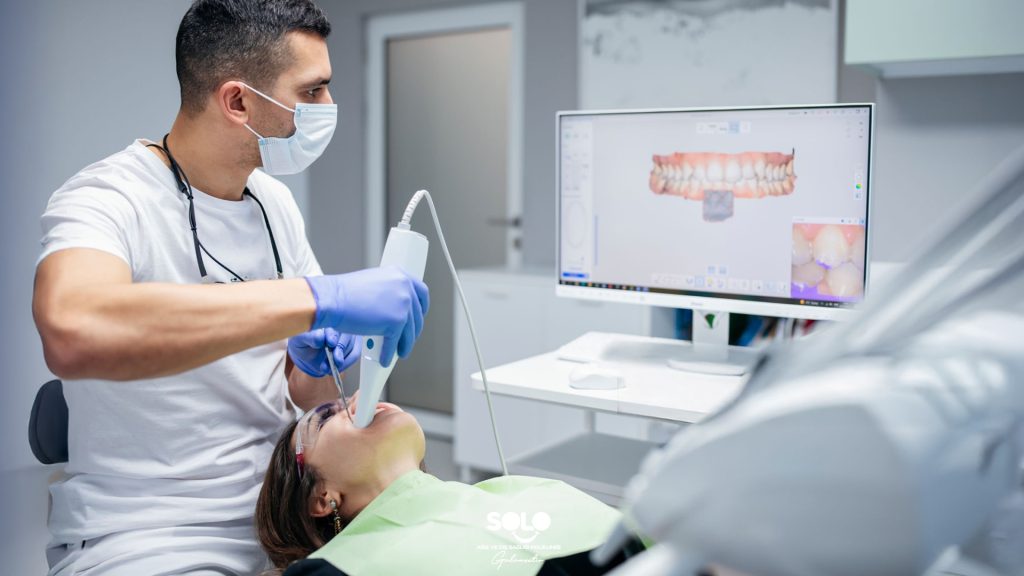
The dentist slowly moves the device over the teeth. The device takes thousands of micro-images in seconds and combines these images to create a three-dimensional model on the screen. You simply sit comfortably; there’s no pressure, squeezing, or gagging.
The resulting model is checked on a computer.
If there’s an area missing or unclear on the digital model displayed on the screen, the doctor rescans that area for a few seconds. This ensures the impression is completed with millimeter accuracy.
The model is instantly delivered to the laboratory.
No more physical impressions that have to be handed over and risk being damaged. The work is digitally sent to the laboratory within seconds, making the process much faster.
The entire procedure is usually completed in just 1–3 minutes. There’s no need for mouthwash, no waiting, and no risk of the impression becoming distorted. In short, it provides perfect comfort for both the doctor and the patient.
What are the Advantages of Digital Impressions?
Digital impressions have become an indispensable part of dentistry today, not just because they are modern technology, but because they significantly improve treatment quality and the patient experience. Their most significant advantage is the high precision they offer. Digital scanners can capture even the smallest details impossible to detect with the naked eye. This allows for nearly perfect results, especially in procedures requiring a perfect fit, such as zirconium crowns, implant-supported dentures, and veneers.
Of course, another major advantage is patient comfort. Taking impressions used to be a stressful time for many: the buildup of toothpaste in the mouth, the pressure that makes breathing difficult, and the occasional nausea reflex. Digital impressions eliminate all of this. Now, a quick scan is all it takes, and the patient can breathe comfortably throughout the procedure.
Additionally, the likelihood of having to retake the impression is virtually eliminated. With traditional impressions, if the material is removed before it has fully hardened, even the slightest movement by the patient could cause the impression to deteriorate. With digital systems, even if there’s a tiny missing area, the physician can rescan that area and complete the model in just a few seconds.
Digital impressions also offer a significant advantage in terms of speed. There’s no longer a need to wait for the impression material to harden in the mouth, nor are there days of waiting to deliver the physical impression to the laboratory. Because all data is sent digitally within seconds, the treatment process is significantly shorter.
Differences Between Digital and Traditional Impressions
The difference between digital and traditional impressions is evident from the first second of the experience. The process is much more comfortable with digital impressions; because there are no pastes, pressure, or uncomfortable trays, the patient feels almost nothing. Furthermore, because the scanner operates with millimeter accuracy, precision is at its highest. With traditional methods, results can vary depending on the material used.
In terms of time, digital impressions are clearly superior; they typically take only 1–3 minutes, while traditional impressions can take up to 5–10 minutes. The likelihood of retakes is quite low with digital impressions, while even the slightest movement with traditional impressions can distort the impression. Another difference emerges during the laboratory process: digital impressions can be instantly transferred to the laboratory via computer, while traditional impressions must be physically transported.
From a cleaning perspective, the digital method offers a much more hygienic experience; there’s no paste, spoon, or other waste material involved. In short, digital measurement clearly stands out in terms of comfort, speed, and accuracy.
Who is Suitable for Digital Impressions?
Digital impressions are a method that most people can easily use. In fact, in many cases, they offer significant advantages over traditional impressions. They are especially beneficial for patients with a strong nausea reflex, as they simply take a quick scan instead of waiting with a toothpaste in their mouth. For those undergoing implant treatment, digital impressions can record the implant’s position in the mouth much more precisely, allowing for a much smoother and more consistent lab work.
Those considering orthodontics, especially those planning clear aligners, can have a much clearer treatment plan thanks to digital impressions. Because the position of the teeth is captured in millimeter detail, aligners can be manufactured more accurately. For patients undergoing zirconium or porcelain veneers, the precision of digital impressions ensures a better fit and a more natural appearance.

